![FictionExpress-tagline (1).png]](https://info.fictionexpress.com/hs-fs/hubfs/FictionExpress-tagline%20(1).png?height=40&name=FictionExpress-tagline%20(1).png)
📥 Download infographic on optimal screen use
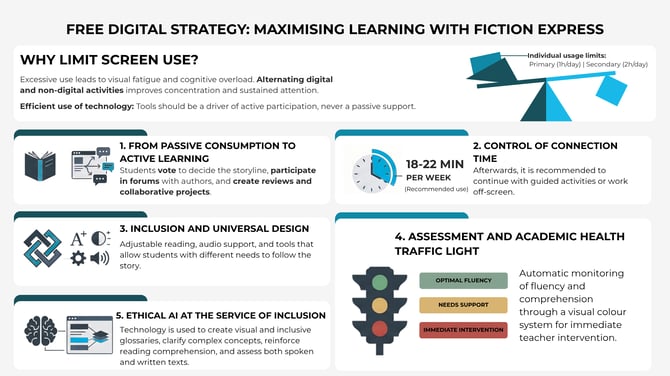
Why talk about screen use?
Current educational guidelines promote limited and purposeful use of screens, especially in the early years.
This means that:
- Screen use must have a clear educational objective
- It should not replace handwriting
- It must allow teacher monitoring and follow-up
- Active use is prioritised over passive consumption
How does Fiction Express fit into this context?
Fiction Express is designed for a flexible and balanced use, combining screen-based activities with offline learning.
✔️ Blended use (screen + paper)
- Digital reading of chapters
- Complementary paper-based activities
- Written production off-screen
✔️ Encouraging active participation
- Making decisions about the story
- Interacting with content
- Developing critical thinking
✔️ Supporting speaking skills
- Classroom discussions
- Justifying decisions
- Expressing opinions
From passive consumption to active learning
A key distinction is between:
❌ Passive use
- Reading without interaction
- Consuming content without reflection
✅ Active use
- Participating in the story
- Making decisions
- Creating, reflecting and expressing ideas
Fiction Express promotes meaningful learning, where students actively take part in the process.
Managing screen time
It is recommended to:
- Use screens for 18–22 minutes per week
- Complement with off-screen activities
This helps to:
- Prevent digital overload
- Maintain attention
- Combine different teaching approaches
Visual assessment system (learning traffic light)
Fiction Express supports progress monitoring through a simple visual system:
- 🟢 Optimal fluency
- 🟡 Needs reinforcement
- 🔴 Teacher intervention required
This system helps to:
- Quickly identify difficulties
- Adjust teaching strategies
- Provide targeted support to each student
Inclusion and accessibility
Technology also enables adaptation to different learning needs:
- Audiobooks
- Adjustable font sizes
- Visual support
- Adapted resources
This supports a more inclusive and personalised learning experience.
Responsible use of technology
The goal is not to increase screen time, but to optimise its use:
- With clear pedagogical intent
- Integrated into classroom practice
- Combined with other learning activities
Key takeaway for the classroom
Reducing screen time does not mean eliminating it, but using it more effectively.
Fiction Express allows reading to be developed:
- In an active way
- With balance
- Always with a clear educational purpose